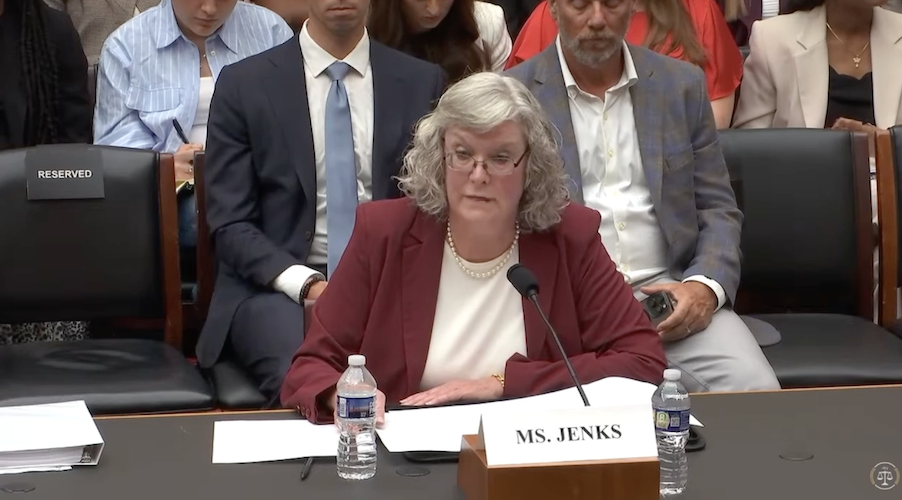
IAP briefs Senate Republicans on DHS funding fight
The Immigration Accountability Project was asked to brief Senate Republicans on Wednesday on Democrats’ demands to add provisions to the DHS spending bill that would severely limit interior enforcement. Funding for DHS expires on Feb 13 if lawmakers can't agree on a bill that would fund the department for the remainder of the fiscal year or pass an extension of current funding.
Nearly every Senate Republican was present when we reviewed the Democrats’ demands and explained their impacts on immigration enforcement. One of the demands—to require ICE to obtain judicial warrants to arrest illegal aliens—would completely cripple enforcement and result in de facto amnesty. We were heartened by their positive responses to our comments!
Earlier in the week, IAP also briefed the staff of House Republican Study Committee (RSC) Members (the RSC includes 189 Congressional Republicans), as well as Senate Conservative staffers, on the Democrats’ wishlist.
As noted above, the most concerning demand from Democratic leaders Sen. Chuck Schumer and Rep. Hakeem Jeffries is to require ICE to obtain a judicial warrant before arresting an illegal alien on private property. The Supreme Court has made it clear that immigration removal is an administrative process, not a criminal one, and the procedures are spelled out in existing law (8 USC 1226). ICE officers would only be able to obtain a warrant from a District Court judge if they had evidence of a crime and intended to prosecute the illegal alien for that crime, if Democrats have their way. A requirement that ICE file criminal charges against, rather than just seeking the administrative removal of, every illegal alien would mean each deportation would take years to accomplish. It would also cause an enormous backlog in the federal courts, assuming District Court judges would issue the warrants at all. In effect, it would make mass deportations impossible.
Schumer and Jeffries are also demanding that ICE officers be prohibited from wearing masks and required to carry visible identification at all times. This would put the lives of ICE officers and their families at risk since anti-ICE protesters have doxxed, threatened, and assaulted a countless number of officers. (Assaults on immigration-enforcement officers are up 1,300 percent, and death threat are up 8,000 percent!) They're also demanding that ICE operations stay clear of sensitive locations, including polling places, courthouses, schools, churches, medical facilities, and more. Not only would this exclude most public areas from enforcement activities, but one has to wonder why illegal aliens would be congregating at polling places.
Based on the response to our briefings, it's unlikely that a long-term spending bill for DHS will pass without Democrats dropping most of their demands. Since ICE and Customs and Border Protection (CBP) personnel are deemed essential workers, they'll continue to work through any shutdown of DHS. But DHS also administers the Coast Guard, TSA, and FEMA, which will all be affected during a shutdown.
SAVE America Act continues to gain momentum
The SAVE America Act, which would require documentary proof of citizenship when registering to vote and a valid photo ID when voting, continues to be a hot topic in Washington. This bill is the new version of the SAVE Act, with the photo ID requirement added to the original version. The House of Representatives is scheduled to vote on this legislation next week.
House Members are looking for ways to add the bill to must-pass legislation, while conservative Senators are huddling with Pres. Trump on strategies to pass the bill in the Senate.
One approach being discussed is to use the "talking filibuster" in the Senate, which would require Senate Democrats to speak continuously on the Senate floor in order to prevent the bill from being passed by a simple majority vote. Pres. Trump has repeatedly voiced his support for reforming the Senate filibuster and passing the SAVE America Act. The talking filibuster has always been in the Senate rules, so employing it wouldn’t be a “nuclear option,” but it requires extended hours of work by a Senate that is used to three-day work weeks.
Sen. Schumer called the Save America Act "Jim Crow 2.0" earlier this week, but polling by Pew Research and highlighted this week by CNN shows overwhelming public support for a voter ID law, including 76% support among Black Americans.
Reps. Strong & Kiggans make biggest moves in Congressional Immigration Rankings
Rep. Dale Strong (R-AL) moved up 22 spots in this week’s release of the Congressional Immigration Rankings at IAPAction.com. Rep. Strong cosponsored H.R. 25, the Legal Workforce Act, which would require all employers to use E-Verify to verify the employment eligibility of new hires. The bill is rated as Key Legislation by IAP Action. Rep. Strong ranks No. 59 among all House Members.
Rep. Jen Kiggans (R-VA) dropped 43 spots after she cosponsored Rep. Maria Salazar’s (R-FL) Dignity Act, H.R. 4393. The Dignity Act would grant amnesty to most illegal aliens living in the United States and is also rated as Key Legislation. Rep. Kiggans ranks No. 201 among House Members.
View the full Congressional Immigration Rankings at IAPAction.com.
Immigration Articles
The Daily Signal: Immigration Enforcement Makes America More Affordable
Steve Cortes of CatholicVote argues that strict immigration enforcement makes America more affordable by reducing competition for jobs and housing, leading to higher wages for blue-collar workers and lower rental prices for citizens.
AP: SBA says legal permanent residents will be ineligible for its loan program, effective March 1
Starting March 1, the Small Business Administration will bar green card holders from its loan programs, reversing previous policies to ensure agency-guaranteed funds exclusively support U.S. citizens.
CIS: Going Back to the Past to Explain ‘Administrative Warrants’, Immigration Enforcement
In a deep dive this week, Art Arthur from the Center for Immigration Studies breaks down the history of administrative and judicial warrants in immigration enforcement, as the topic has taken center stage in the recent debate over ICE reform.
Next Week
The House and Senate will return next week to address DHS funding prior to the deadline on Friday. Both the House Homeland Security Committee and the Senate Homeland Security and Government Affairs Committee will have hearings featuring the heads of ICE, CBP, and USCIS.
Commentary - Board of Immigration Appeals Cleans Up Precedents to Stop Fraud
Commentary - U.S. Electoral System is Like a Bank Without a Vault

Commentary - Obama Created the CDL Mess and Trump's Cure is Model to Protect Labor

Commentary - OP-ED: Cognizant Crackdown